How Leaders Can Improve Employee Engagement and Performance
The secret to sustainable business success is deceptively simple: engaged employees. Discover our holistic model to empower leaders and help them create welcoming, inclusive, and supportive workplaces.

The secret to sustainable business success is deceptively simple: engaged employees. Thriving companies balance individual fulfillment and organizational excellence—simultaneously meeting the needs of the workforce and the marketplace. Yet many businesses struggle to keep their employees motivated, because no single initiative works with every individual. To solve this challenge, Workplace Options (WPO) has developed a holistic model to empower leaders and help them create welcoming, inclusive, and supportive workplaces. When employees are valued for who they are, they are happier, healthier, and more productive, enabling their companies to win in the marketplace.
Defined as the involvement and enthusiasm of employees in their work and workplace, employee engagement is tightly linked to financial performance, customer satisfaction, and innovation (Source: Drucker Institute). High-performing teams align the goals and objectives of the organization with personal priorities, enabling team members to find meaning and purpose in work, further fueling employee engagement. This alignment of personal and professional values is especially important for members of the Gen Z and millennial generations.
The Employee Engagement Growth Model
Organizational Objectives: Employee Engagement
Team Outcomes: Collaboration | Productivity | Innovation | Retention
Individual Needs: Wellbeing | Belonging | Trust | Meaningful Work
Leadership Strategies: Communication | Psychological & Physical Safety | Opportunity Systems | Relationship-Building | Inclusive Leadership | Career Navigation
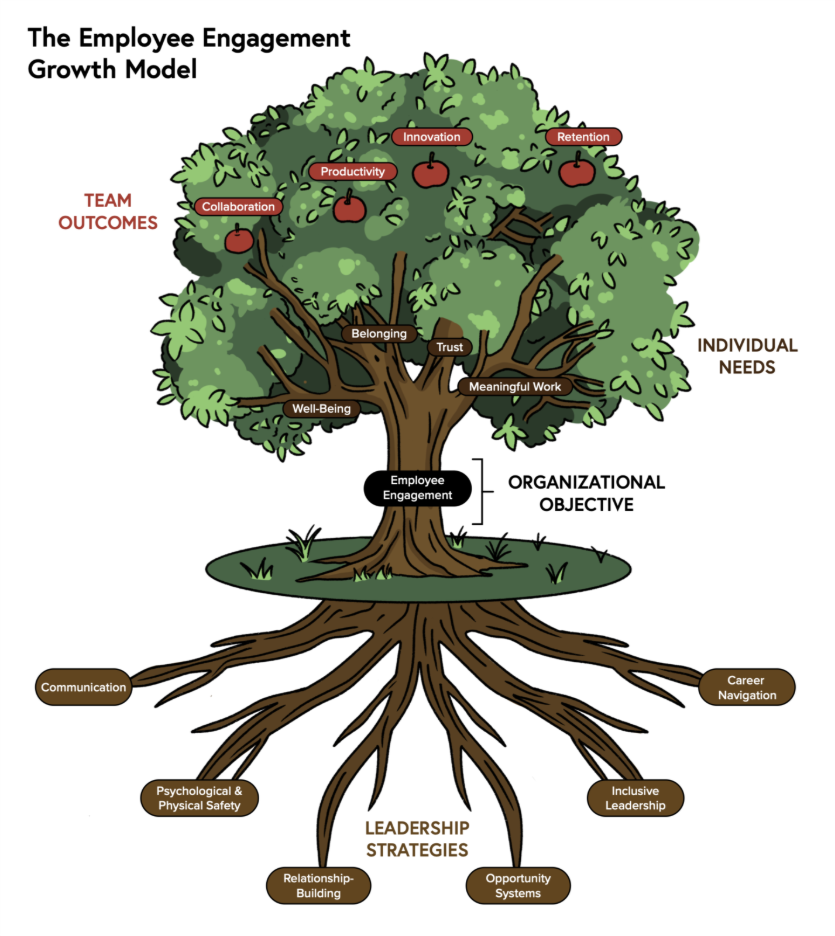
The Employee Engagement Growth Model (EEGM) gives executives and leadership teams a framework to achieve financial and business goals by creating an environment where individual employees thrive. It blends relationships and care with productivity and clarity to create outcomes that generate sustainable success for organizations. It’s important to view employee engagement as a dynamic ecosystem, with each element supporting another. The tree motif reminds leaders that engagement must be consistently cultivated, nourished by intentional leadership strategies. The needs of employees also change, evolving over time and reacting to outside influences that effect performance.
When leaders employ these proven strategies, Individual Needs (well-being, belonging, trust and meaningful work) are met, leading to better Team Outcomes (collaboration, productivity, innovation and retention). The following "win-win" strategies are key to employee engagement, team performance, and sustainable organizational success.